

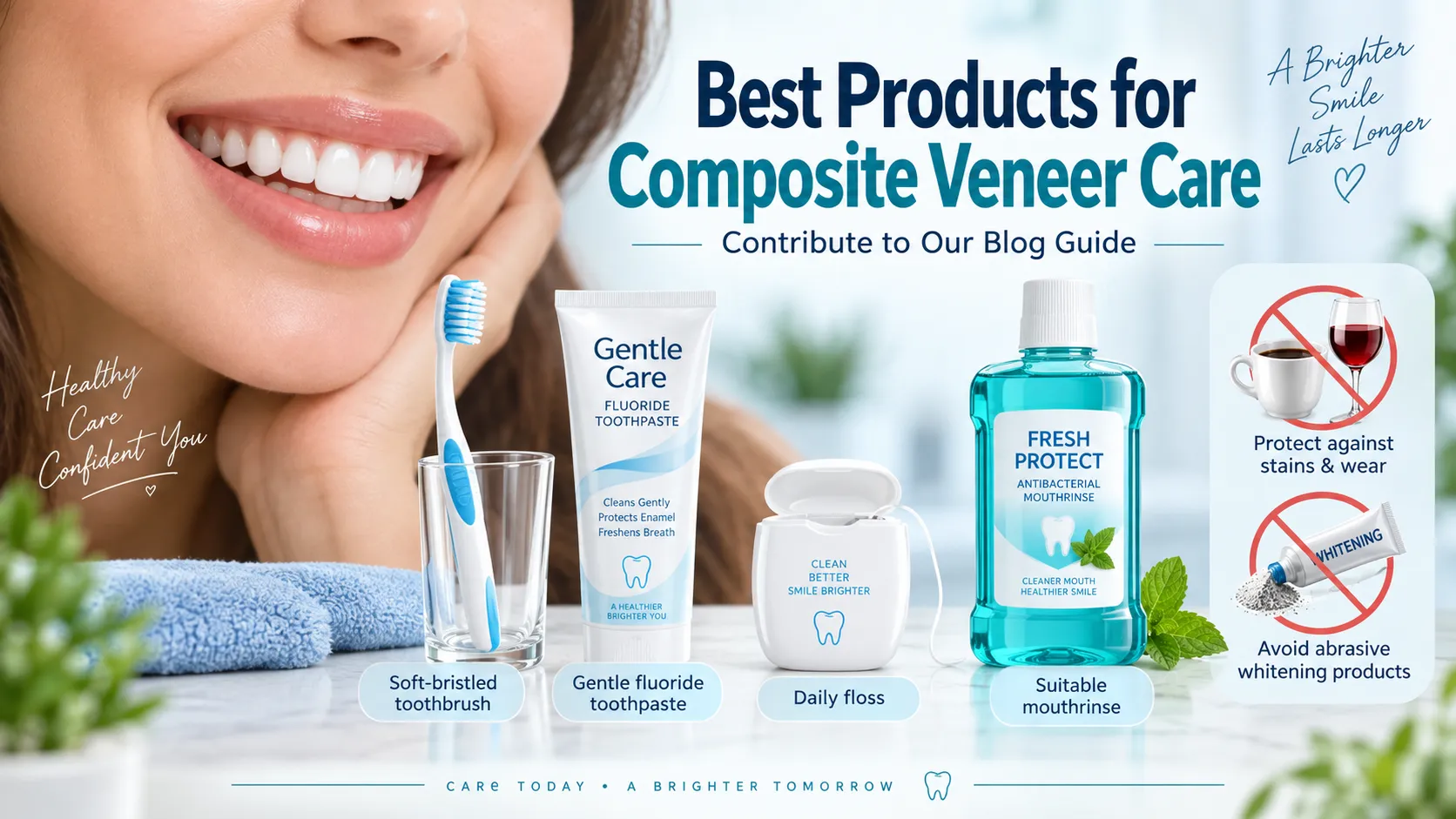
The best products for composite veneer care are a soft-bristled toothbrush, a gentle fluoride toothpaste, daily floss or another interdental cleaner, and, when appropriate, a suitable mouthrinse. If you searched for best products for composite veneer care contribute to our blog, the most important point is to protect the composite resin from unnecessary abrasion, staining, and physical damage while also keeping the teeth and gums underneath healthy.
Composite veneers are made from tooth-colored resin that is bonded and sculpted directly onto the tooth. They can look highly natural and are generally easier to repair than porcelain veneers, but the American Dental Association notes that composite veneers are not as resistant to staining or wear.
That difference matters when choosing toothpaste, brushes, mouthwash, whitening products, and other everyday dental-care products.
What Composite Veneers Actually Need From Daily Care
A composite veneer does not need a complicated collection of specialist products. A good routine needs to accomplish three things: control plaque, protect the surrounding natural tooth and gums, and avoid unnecessarily rough treatment of the polished resin surface.
The ADA recommends brushing twice daily for two minutes with fluoride toothpaste and cleaning between the teeth every day. Its veneer-specific guidance also advises people to be cautious with coffee, tea, red wine, hard foods, nail biting, and other habits that can discolor or damage veneers.
Composite resin deserves slightly more attention than natural enamel because its surface properties can change over time. Laboratory and clinical research has found that staining, polishing quality, toothpaste formulation, brushing, and the particular composite material used can all affect color or surface roughness.
Best Products for Composite Veneer Care Contribute to Our Blog Recommendations
There is no single brand that is scientifically proven to be the best choice for every composite veneer. The material used by the dentist, how well it was polished, the patient’s bite, diet, brushing pressure, and oral-health needs all affect product selection.
A practical evidence-based shopping list looks like this:
| Product type | What to choose | Why it matters |
|---|---|---|
| Toothbrush | Soft-bristled manual brush or suitable powered brush | Removes plaque without requiring aggressive scrubbing |
| Toothpaste | Fluoride toothpaste with a gentle or low-abrasion formulation | Protects natural tooth structure while limiting unnecessary abrasion |
| Interdental cleaner | Floss, dental tape, or appropriately sized interdental cleaner | Cleans veneer margins and spaces a toothbrush cannot reach |
| Mouthwash | Optional rinse selected for a genuine oral-health need | Can supplement brushing and flossing but should not replace them |
| Night guard | Dentist-fitted guard when grinding or clenching is present | Reduces mechanical stress on teeth and restorations |
| Sports mouthguard | Properly fitted athletic guard | Helps protect veneers and teeth from impact |
The ADA Seal of Acceptance is also useful when comparing products because accepted products have been reviewed for the safety and effectiveness claims they make. More than 400 oral-care products across categories currently carry the Seal.
1. Choose a Soft-Bristled Toothbrush
A soft-bristled toothbrush is the safest general starting point for composite veneer care. The ADA recommends soft bristles and gentle brushing pressure because these reduce the risk of injury to gums while still removing plaque effectively.
Both manual and powered toothbrushes can work well. An expensive electric toothbrush is not automatically better for a veneer simply because it has more cleaning modes.
What matters most is technique. Avoid pressing hard or aggressively scrubbing across the veneer and gumline.
For people who prefer electric brushing, ADA-accepted powered toothbrushes are available. For example, several Oral-B oscillating-rotating models, including the Oral-B Pro 1000 and other models listed by the ADA, have earned the Seal for plaque removal and gingivitis reduction.
The Seal does not specifically certify a toothbrush as a “composite veneer brush,” so people with extensive bonding should still discuss brush heads and pressure with their dentist.
2. Use a Gentle Fluoride Toothpaste
Fluoride remains important even when the visible front of a tooth is covered by composite. A veneer does not eliminate the possibility of decay developing around its edges or elsewhere on the tooth.
The ADA specifically recommends brushing veneers with fluoride toothpaste twice daily.
For composite restorations, a conventional or low-abrasion fluoride toothpaste is usually a more conservative everyday choice than repeatedly using highly abrasive products in an attempt to polish or whiten the resin.
A Practical Example: Sensodyne Pronamel
Sensodyne Pronamel Daily Protection and related non-aggressive formulations are reasonable examples of the type of toothpaste to consider. Haleon’s professional information describes several Pronamel formulations as low-abrasion fluoride toothpastes.
This does not mean Pronamel has been proven to extend the life of composite veneers specifically, nor is it the only suitable option. It simply combines two useful characteristics: fluoride for natural tooth protection and a formulation specifically described as low abrasion.
People can also look for other conventional fluoride toothpastes and discuss the exact product with the dentist who placed the composite.
3. Be Careful With Whitening Toothpaste
Whitening toothpaste deserves special attention because many people with cosmetic dentistry naturally want to preserve a bright smile.
The problem is that whitening toothpastes often depend partly on abrasive ingredients to remove surface stains. The ADA explains that whitening toothpastes mainly remove extrinsic stains rather than bleaching restorative material.
Research on composites is not completely uniform. Some studies have found little difference between conventional and whitening toothpastes, while others have observed greater surface roughness after prolonged brushing with certain whitening formulas.
A 2026 laboratory study similarly found that some whitening toothpastes could increase the surface roughness of the tested resin composite.
The safest interpretation is not that every whitening toothpaste destroys composite veneers. Instead, there is enough material-dependent evidence to avoid routinely choosing a highly abrasive whitening paste when a normal fluoride toothpaste can meet everyday oral-care needs.
4. Charcoal Toothpaste Is Usually a Poor First Choice
Activated-charcoal toothpaste is frequently marketed as a natural whitening option, but it is difficult to justify as the default product for someone trying to preserve polished composite work.
A 2024 systematic review examined charcoal and conventional whitening toothpastes in relation to composite resin color and roughness. The available studies raised concerns about surface changes, although the evidence was primarily laboratory based.
Other experiments have found charcoal-containing whitening dentifrices among the more abrasive formulations tested against certain composites.
Because composite veneers depend partly on a smooth, highly polished surface for their appearance, there is little reason to choose a potentially aggressive charcoal product without a specific recommendation from the treating dentist.
5. Floss Is One of the Most Important Products
Composite veneers do not make flossing optional.
Plaque can build up between teeth and around restoration margins where a toothbrush cannot clean effectively. The ADA recommends cleaning between the teeth once daily using floss or another suitable interdental cleaner.
Waxed and unwaxed floss are both acceptable. The ADA notes that technique and consistent use matter more than whether traditional floss is waxed or unwaxed.
One example with the ADA Seal is Oral-B Glide Pro-Health Floss, which the ADA has accepted for removing plaque between teeth and helping prevent or reduce gingivitis.
The important part is not the brand. Floss should slide through the contact gently rather than being snapped forcefully toward the gums or restoration.
If floss repeatedly catches, shreds, or becomes stuck around a composite veneer, contact the dentist. A rough margin, excess bonding material, or another restoration issue may need professional evaluation rather than stronger floss.
6. Mouthwash Can Help, but It Is Optional
Mouthwash is not essential for everyone with composite veneers. It can be useful when there is a specific reason, such as additional plaque or gingivitis control, but it does not replace brushing and interdental cleaning.
The ADA states that antimicrobial mouthrinses can provide additional benefits for some patients, while emphasizing that rinsing is not a substitute for mechanical cleaning.
One current example is Colgate Total Active Prevention Mouthwash. It carries the ADA Seal for helping reduce plaque and gingivitis, and Colgate describes the product as alcohol-free.
That does not make it universally necessary for composite veneers. If the gums are healthy and plaque is well controlled, a dentist may see no need for a daily antimicrobial rinse.
Be Cautious With Chlorhexidine
Chlorhexidine is different from an ordinary cosmetic mouthwash. It is an effective antimicrobial agent used for specific dental indications, but staining is a recognized side effect.
The ADA notes that chlorhexidine and some cetylpyridinium chloride rinses can cause brown staining of teeth, the tongue, or restorations.
For this reason, chlorhexidine should not be adopted casually as a permanent veneer-care product. Use it according to professional instructions when it has been recommended for an oral-health problem.
Can Tooth Whitening Make Composite Veneers Whiter?
Not in the same way that it whitens natural teeth.
The ADA states clearly that tooth-colored restorations do not whiten like natural tooth structure. Bleaching natural teeth around a composite veneer can therefore create a color mismatch instead of making the entire smile uniformly brighter.
If composite veneers have become dull or superficially stained, professional evaluation is more useful than repeatedly applying stronger whitening products.
Depending on the cause, a dentist may be able to polish the surface, repair a small area, or replace the restoration if discoloration is deeper.
Older research on composite veneering materials found that professional repolishing could substantially reduce staining. More recent reviews also recognize polishing as an important factor affecting the appearance of resin-based restorations.
Products Cannot Completely Prevent Composite Veneer Staining
No toothpaste or mouthwash can make composite resin stain-proof.
Coffee, tea, wine, smoking, material composition, surface finish, and exposure time can all influence discoloration. Recent reviews continue to find that pigmented drinks can produce visible color changes in resin-based materials, although the amount varies considerably among different composites.
This does not mean everyone with composite veneers must stop drinking coffee or tea. A more practical approach is to limit prolonged exposure, maintain good oral hygiene, rinse the mouth with water afterward when convenient, and attend dental visits so the restoration can be checked and polished when appropriate.
The ADA specifically advises veneer patients to be cautious with coffee, tea, and red wine because they may contribute to discoloration.
Protecting Composite Veneers From Chipping and Wear
The right products matter, but physical habits can have an even larger effect on veneer longevity.
Avoid using veneered teeth to open packaging, bite pens, chew ice, or bite fingernails. The ADA warns that veneers can chip, crack, wear, or loosen, and specifically advises avoiding hard objects and nail biting.
People who grind or clench their teeth should discuss protection with a dentist. The ADA’s MouthHealthy guidance says that a dentist may recommend a custom night guard for people who grind their teeth, and notes that professionally made guards generally provide a closer fit than many over-the-counter versions.
For contact sports or activities with a risk of facial impact, use a proper sports mouthguard rather than a night guard.
A Simple Daily Composite Veneer Routine
An effective routine does not need to be complicated:
- Brush for two minutes in the morning with a soft-bristled brush and fluoride toothpaste.
- Brush again before bed using gentle pressure.
- Clean between every tooth once daily with floss or another appropriate interdental cleaner.
- Use mouthwash only when it serves a useful oral-health purpose or has been recommended.
- Avoid routinely scrubbing veneers with charcoal powders or aggressive whitening products.
- Protect the teeth from grinding, sports injuries, nail biting, ice chewing, and similar stresses.
- Maintain regular dental examinations and professional cleaning based on your dentist’s recommended schedule.
The surrounding tooth structure remains biologically important even when the front surface looks completely covered. Cavities and gum disease can still develop around veneers, which is why ordinary preventive dentistry remains essential.
What to Look for When Buying Composite Veneer Care Products
Packaging can be confusing because terms such as “whitening,” “deep clean,” “polishing,” “natural,” and “professional strength” are primarily marketing descriptions unless tied to a clearly defined claim.
For routine veneer care, prioritize a few practical characteristics:
- Fluoride toothpaste for cavity protection
- A gentle or low-abrasion formula when available
- Soft toothbrush bristles
- An interdental product you can use comfortably every day
- ADA Seal products when available for the claimed purpose
- Products recommended for your specific restoration by the dentist who placed it
Do not assume that a product labeled “for veneers” has undergone specialized testing on your particular composite material.
Also remember that Relative Dentin Abrasivity, or RDA, measures abrasion of dentin under standardized testing. It should not be treated as a universal numerical rating of how a toothpaste will behave on every composite resin.
When Home-Care Products Are Not Enough
A new rough edge, visible crack, persistent discoloration, floss catching around a veneer, pain, sensitivity, gum swelling, or a change in the way the teeth meet deserves professional assessment.
Composite veneers are repairable in many situations, which is one of their advantages. But attempting to polish, file, bleach, or repair one at home can make a minor problem more difficult to correct.
The ADA also recommends telling your dentist if the bite does not feel right after composite veneer placement so it can be evaluated and adjusted.
FAQ
What toothpaste is best for composite veneers?
A fluoride toothpaste with a gentle, non-aggressive formulation is a sensible everyday choice. Low-abrasion products such as certain Sensodyne Pronamel formulations are examples, but the ideal toothpaste depends on the composite material, your cavity risk, sensitivity, and your dentist’s recommendations.
Can I use whitening toothpaste on composite veneers?
Occasional use of some whitening toothpastes may not cause obvious problems, but research shows that certain formulations can increase the roughness of some composite materials. A conventional gentle fluoride toothpaste is therefore a more conservative routine choice unless your dentist recommends otherwise.
Can I use an electric toothbrush on composite veneers?
Yes. Both manual and powered toothbrushes can remove plaque effectively. Use gentle pressure and an appropriate brush head rather than aggressively scrubbing the veneers.
Does mouthwash damage composite veneers?
Most mouthwashes are not automatically harmful to composite restorations, and a systematic review found that most tested rinses did not produce clinically unacceptable composite color changes. However, effects vary by formulation and restorative material, and chlorhexidine and some other antimicrobial ingredients can contribute to staining.
How can I keep composite veneers from staining?
Brush regularly, clean between the teeth, limit repeated exposure to strongly pigmented substances such as coffee, tea, and red wine, and have the veneers professionally assessed if they become noticeably dull. The quality of the composite and its polished surface also influence stain resistance.
Can stained composite veneers be professionally polished?
Often, superficial staining can be improved by professional repolishing, although the result depends on the depth and cause of the discoloration. Deeper color changes or damaged composite may require repair or replacement instead.
Also Read: Beauty Lifestyle Fashion Blog Favorite Products Skin Travel
