

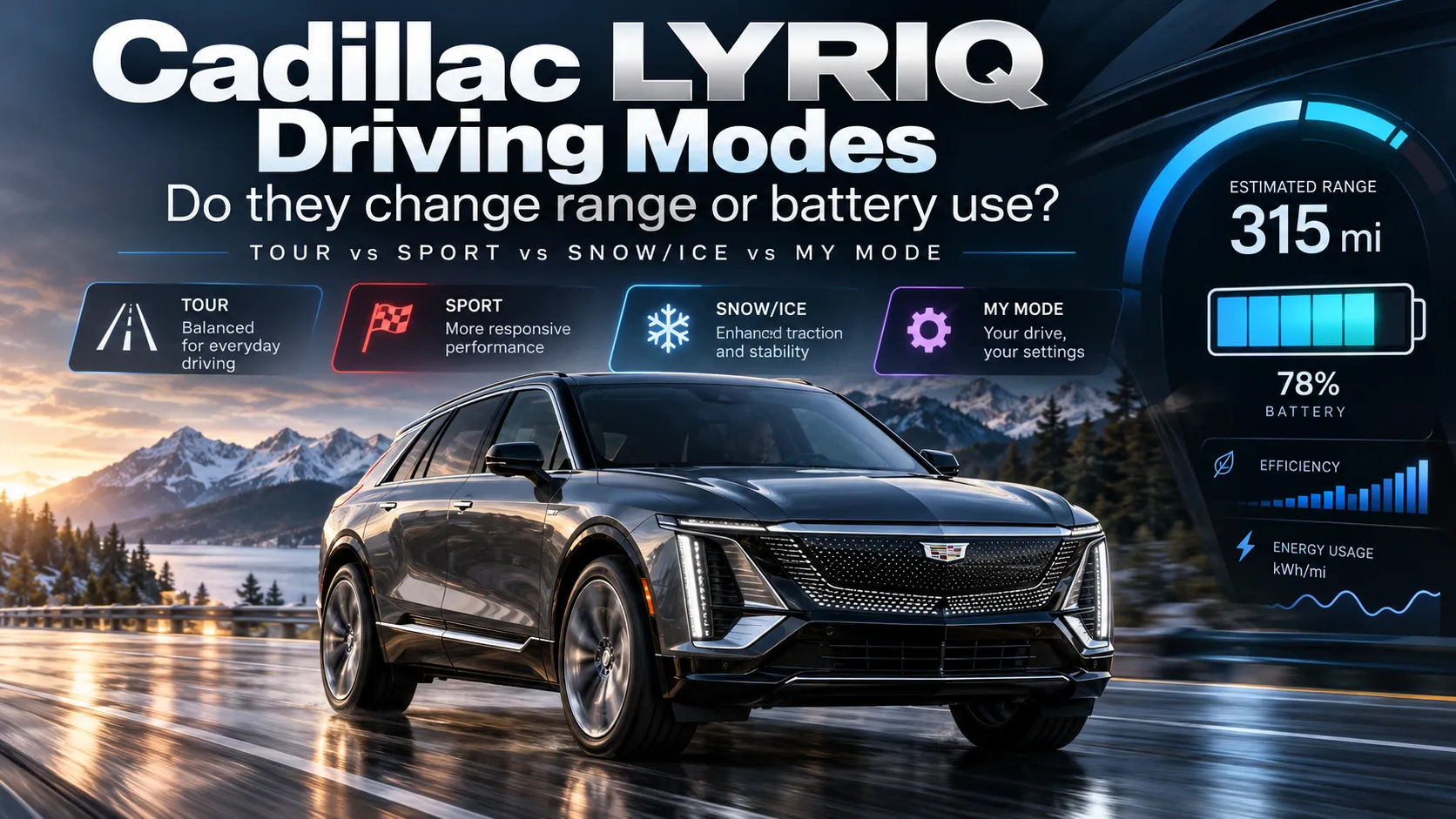
Yes, the Cadillac LYRIQ’s driving modes can affect battery consumption and real-world driving range, but they do not have separate, officially rated mileage figures. Tour Mode is generally the best choice for everyday efficiency, while Sport Mode can increase energy consumption when its more responsive acceleration encourages aggressive driving. Snow/Ice Mode prioritizes traction, and My Mode allows drivers to customize vehicle behavior.
The important distinction is that a driving mode changes how the Cadillac LYRIQ responds, not the physical capacity of its battery. A driver who accelerates smoothly in Sport Mode may achieve similar efficiency to someone using Tour Mode. Conversely, frequent hard acceleration in Tour Mode can still reduce range considerably.
According to Cadillac’s official documentation, the LYRIQ uses its driving modes to adjust acceleration response, steering, suspension, and other systems, depending on the vehicle’s equipment. Cadillac does not publish a separate EPA range for each selectable driving mode.
Understanding these differences can help LYRIQ owners choose the right settings, preserve battery energy, and plan longer journeys more confidently.
Do the Driving Modes in Cadillac Lyriq Offer Different Ranges or Battery Usages?
The Cadillac LYRIQ offers several selectable driving modes, primarily Tour, Sport, Snow/Ice, and My Mode. The performance-oriented LYRIQ-V also offers V-Mode and a separate Velocity Max function.
Each mode changes certain aspects of the driving experience, but battery usage depends heavily on what the driver does with those settings.
| Driving mode | Main purpose | Potential effect on range |
|---|---|---|
| Tour Mode | Comfortable, balanced everyday driving | Generally the most practical choice for efficiency |
| Sport Mode | Sharper acceleration response and handling | Can increase battery consumption with aggressive driving |
| Snow/Ice Mode | Improved traction on slippery roads | Variable, depending on temperature, traction, and driving conditions |
| My Mode | Personalized acceleration, braking, and steering | Depends on selected settings and driving behavior |
| V-Mode (LYRIQ-V) | Customizable performance-oriented driving | Can encourage higher energy consumption |
| Velocity Max (LYRIQ-V) | Maximum propulsion performance | Extended use reduces range, according to Cadillac |
These comparisons describe expected real-world behavior, not manufacturer-tested efficiency rankings for individual modes. A particular driving mode does not guarantee a fixed percentage increase or decrease in range.
Cadillac’s 2026 owner’s manual confirms the mode availability and tuning differences, including the additional performance settings for the LYRIQ-V.
Also Read: Sosoactive: What It Is and How It Operates
How Each Cadillac LYRIQ Driving Mode Affects Battery Usage
1. Tour Mode: The Best Everyday Choice for Battery Efficiency
Tour Mode is designed for comfortable city and highway driving. It provides balanced acceleration response, steering, handling, and ride comfort.
Cadillac describes Tour Mode as suitable for normal driving, and its broader Driver Mode Control guidance identifies Tour/Normal as the preferred everyday setting for economical operation.
Unlike a dedicated energy-saving mode that substantially restricts vehicle performance, Tour Mode maintains a familiar balance between smoothness and responsiveness.
Its potential efficiency advantages come primarily from encouraging controlled acceleration and predictable vehicle behavior.
For example, when leaving a traffic signal, a driver using Tour Mode may find it easier to accelerate progressively rather than requesting substantial power immediately.
That smoother driving style can help reduce unnecessary energy consumption.
Tour Mode is particularly suitable for:
- Daily commuting and city driving.
- Long-distance highway journeys.
- Drivers prioritizing comfort and predictable handling.
- Owners trying to maintain consistent battery efficiency.
However, selecting Tour Mode does not automatically maximize range. Driving speed, temperature, road conditions, and acceleration remain important.
2. Sport Mode: Does Better Performance Mean Higher Battery Consumption?
Sport Mode makes the Cadillac LYRIQ feel more responsive. Depending on the vehicle’s equipment, it modifies accelerator pedal tuning, steering effort, suspension behavior, electric motor sound enhancement, and adaptive cruise control characteristics.
Cadillac recommends Sport Mode when road conditions or driver preferences call for a more controlled, performance-oriented response, particularly on dry pavement.
The main efficiency concern is acceleration.
When the accelerator becomes more responsive, drivers may request higher motor output more frequently. Repeated hard acceleration draws substantial electrical power and can increase energy consumption over a journey.
However, Sport Mode does not automatically drain the battery significantly faster simply because it is selected.
Consider two scenarios.
In the first, a LYRIQ driver selects Sport Mode but maintains a consistent highway speed, avoids unnecessary acceleration, and drives smoothly.
In the second, another driver uses Tour Mode but repeatedly accelerates aggressively and brakes sharply.
The second driver could consume more energy despite using the nominally more economical driving mode.
This demonstrates why driving behavior matters more than the mode label alone.
There is also no verified Cadillac figure establishing that Sport Mode reduces LYRIQ range by a specific percentage, such as 10% or 15%. Such figures should not be treated as official specifications.
3. Snow/Ice Mode: Designed for Traction, Not Maximum Range
Snow/Ice Mode helps the LYRIQ respond more predictably on low-traction surfaces.
It changes accelerator pedal behavior to manage power delivery and reduce unnecessary wheelspin. On equipped vehicles, the system also adjusts electric all-wheel-drive operation.
Cadillac’s owner’s manual notes that these settings improve traction on slippery roads but can compromise acceleration on dry pavement.
Snow/Ice Mode is therefore a safety- and traction-oriented setting rather than a dedicated battery-saving feature.
Its impact on range is difficult to separate from winter driving conditions.
Cold temperatures can reduce battery performance, while cabin heating requires additional energy. Snow-covered roads and increased rolling resistance may also affect efficiency.
The U.S. Environmental Protection Agency confirms that cold weather, accessory use, and higher driving speeds can substantially influence electric vehicle range.
Although Snow/Ice Mode moderates power delivery, that does not mean it compensates for all the energy losses associated with cold-weather driving.
Use Snow/Ice Mode when road conditions justify it, even if maximizing range is also a priority. Maintaining traction and control is more important than attempting to save a small amount of battery energy.
4. My Mode: Can Custom Settings Improve LYRIQ Range?
My Mode allows Cadillac LYRIQ drivers to personalize several vehicle characteristics.
According to the 2026 owner’s manual, available customization settings can include:
- Acceleration Feel: Relaxed, Tour, or Sport.
- Brake Feel: Tour or Sport.
- Steering: Tour or Sport.
- Suspension: Tour or Sport.
- Motor Sound: Different settings depending on the model.
My Mode settings are retained when the vehicle is switched off and restarted.
For drivers who prefer smoother accelerator behavior, choosing Relaxed acceleration can make it easier to apply power progressively.
That may encourage more efficient driving, particularly in stop-and-go traffic.
However, Relaxed acceleration should not be confused with an officially certified economy setting.
Cadillac does not provide a separate EPA range estimate for a LYRIQ operating in My Mode with Relaxed acceleration selected.
The practical benefit is greater control over how the vehicle responds to driver inputs.
5. V-Mode and Velocity Max: Performance Settings on the LYRIQ-V
The 2026 Cadillac LYRIQ-V includes additional performance-focused functionality.
V-Mode allows drivers to customize dynamic vehicle behavior, including acceleration response, braking, steering, suspension, and other performance settings.
Velocity Max is a separate function that changes propulsion settings to provide additional motor torque and maximum performance.
Importantly, Cadillac explicitly states in its 2026 owner’s manual that extended use of Velocity Max reduces driving range and that the function is not intended for everyday use.
This is a clearer manufacturer-confirmed range warning than the general assumptions often made about Sport Mode.
Owners seeking maximum driving distance should therefore avoid extended performance-oriented driving and reserve Velocity Max for appropriate situations.
Also Read: TheJavaSea.me Leaks AIO-TLP371: What You Need to Know
Cadillac LYRIQ Battery Capacity and Official Driving Range
Before comparing driving modes, it is useful to understand the LYRIQ’s actual battery specifications.
The 2026 Cadillac LYRIQ has a battery pack with a rated energy capacity of approximately 102 kilowatt-hours (kWh).
A kilowatt-hour is a measurement of electrical energy. In simple terms, it represents how much energy the battery can store, rather than how quickly it delivers power.
The LYRIQ’s official driving range varies by drivetrain and equipment configuration.
2026 Cadillac LYRIQ EPA-Estimated Range
| 2026 model configuration | EPA-estimated range |
|---|---|
| LYRIQ Single-Motor RWD | 326 miles |
| LYRIQ Dual-Motor AWD, standard 11.5 kW onboard charging | 319 miles |
| LYRIQ Dual-Motor AWD, available 19.2 kW onboard charging | 303 miles |
| LYRIQ-V Dual-Motor AWD | 285 miles |
Source: Cadillac’s published 2026 LYRIQ specifications. Figures apply to the listed vehicle configurations, not individual driving modes.
The differences between these estimates should not be confused with the effects of changing drive modes.
Rear-wheel-drive and all-wheel-drive LYRIQ models have different propulsion hardware, while the LYRIQ-V is a distinct performance variant.
Similarly, the 11.5 kW and 19.2 kW figures describe onboard AC charging equipment. Selecting a slower charging current does not convert a 303-mile configuration into a 319-mile configuration.
EPA estimates provide a standardized comparison of vehicles, not a guarantee of how far a particular LYRIQ will travel under all driving conditions.
The EPA explains that its range testing accounts for representative city and highway driving and adjustments for real-world factors.
Why Driving Style Matters More Than the Selected Mode
Battery energy consumption is influenced by how much power a vehicle needs to accelerate, maintain speed, overcome resistance, and operate auxiliary systems.
Driving modes can change the driver’s interaction with those systems, but they cannot eliminate the physical energy required to move the vehicle.
Acceleration and Braking
Rapid acceleration requires greater instantaneous motor power than gradual acceleration.
Although electric motors are efficient, repeatedly increasing the vehicle’s speed and then slowing down wastes more energy than maintaining a steady, appropriate speed.
The LYRIQ’s regenerative braking system can recover part of the vehicle’s kinetic energy during deceleration, but it cannot recover all of it.
Cadillac recommends avoiding unnecessary acceleration and deceleration to improve efficiency.
Highway Speed
Higher speeds generally increase aerodynamic resistance.
Because the LYRIQ is a relatively large luxury electric SUV, maintaining high speeds can require considerable energy.
Cadillac specifically identifies higher vehicle speeds and changes in road grade as factors that can significantly reduce electric driving range.
A driver maintaining moderate highway speeds in Sport Mode may therefore achieve better efficiency than someone driving substantially faster in Tour Mode.
Heating, Air Conditioning, and Battery Temperature
Climate control can have a meaningful impact on range, especially in very hot or cold weather.
The LYRIQ uses battery energy to heat or cool the passenger compartment when it is not connected to external power.
Cadillac recommends preconditioning the cabin while the vehicle is plugged in when possible, reducing the amount of battery energy needed after departure.
The 2026 owner’s manual also describes ECO Climate, which reduces airflow to unoccupied rear seats to save energy. This is a climate-control feature, not an additional propulsion driving mode.
Consequently, adjusting cabin temperature and using preconditioning can be more useful for range preservation than repeatedly switching between Tour and My Mode.
Does Regenerative Braking Change Battery Usage in Different Modes?
Yes, regenerative braking can improve the LYRIQ’s overall energy efficiency, but its benefits depend on how and where the vehicle is driven.
Regenerative braking converts some of the energy associated with vehicle movement into electricity and returns it to the high-voltage battery.
The LYRIQ provides two useful driver-controlled features.
One-Pedal Driving
One-Pedal Driving allows drivers to manage acceleration and deceleration primarily through the accelerator pedal.
When the driver releases the accelerator, the vehicle slows down, using regenerative braking when available.
This can be especially convenient in urban driving, where frequent slowing and stopping are common.
However, One-Pedal Driving does not guarantee better efficiency in every situation. Unnecessary deceleration followed by acceleration can still waste energy.
Regen On Demand
Regen On Demand allows the driver to increase deceleration using a paddle behind the steering wheel.
According to Cadillac, this feature can be used independently or together with One-Pedal Driving.
It is particularly useful when drivers anticipate slowing down and want to recover some energy rather than relying entirely on conventional friction braking.
Important Regenerative Braking Limitations
Regenerative braking may be reduced when the battery is nearly full or its temperature is extremely high or low.
Cadillac also advises against using One-Pedal Driving and Regen On Demand on slippery roads, including snowy or icy surfaces.
In these conditions, drivers should use the conventional brake pedal and follow the vehicle’s safety guidance.
Regeneration is best understood as an efficiency aid, not a method of creating extra battery capacity.
Also Read: NewAnonIB: Website Overview, History, Safety and Risks in 2026
How to Compare Battery Consumption Between Tour and Sport Modes
Owners interested in actual efficiency differences can compare their vehicle’s energy-use readings over similar routes.
The 2026 LYRIQ owner’s manual identifies an Energy Info feature within the Vehicle Status app. This provides information about energy consumption during the current drive and over recently traveled distances.
Depending on the display, owners can examine energy used for driving, remote climate operation, and other systems.
A meaningful comparison involves driving the same route under similar conditions.
For example, a driver could complete a familiar journey using Tour Mode and then repeat it with Sport Mode.
To make the comparison more useful, keep the following factors as consistent as possible:
- Route and distance: Use the same journey in both directions where practical, accounting for elevation changes.
- Driving speed: Maintain similar speeds and obey the same traffic conditions.
- Climate settings: Keep heating and air conditioning settings comparable.
- Vehicle load: Avoid major differences in passengers or cargo.
- Battery and weather conditions: Compare journeys with similar battery temperatures and weather.
- Driving behavior: Avoid unusually hard acceleration during either test.
Record the distance traveled and battery energy consumed rather than relying exclusively on the estimated miles remaining.
Understanding Energy Consumption in kWh
A useful way to compare EV efficiency is kilowatt-hours consumed per 100 miles.
Consider this hypothetical example:
| Measurement | Tour Mode | Sport Mode |
|---|---|---|
| Distance driven | 100 miles | 100 miles |
| Battery energy consumed | 30 kWh | 36 kWh |
| Energy consumption | 30 kWh/100 miles | 36 kWh/100 miles |
Illustrative calculation only. These are not measured Cadillac LYRIQ results or manufacturer-certified mode figures.
In this example, the Sport Mode journey used 20% more energy than the Tour Mode journey.
However, the comparison alone would not establish that Sport Mode caused the entire difference. Changes in acceleration, speed, weather, or traffic could also explain the outcome.
Repeating the comparison across several journeys can provide a more reliable picture of an individual driver’s energy consumption.
Practical Ways to Maximize Cadillac LYRIQ Driving Range
The most effective range-saving strategies involve combining an appropriate driving mode with efficient driving habits.
Choose Tour Mode for Regular Driving
Tour Mode offers a sensible balance of comfort, performance, and predictable acceleration.
It is generally the best starting point for owners prioritizing battery efficiency, especially during longer journeys.
Accelerate Smoothly and Anticipate Traffic
Gradual acceleration reduces unnecessary demands for high motor power.
Looking ahead, maintaining sufficient following distance, and slowing down progressively can also reduce unnecessary braking.
Use Regenerative Braking Appropriately
One-Pedal Driving and Regen On Demand can help recover energy during deceleration.
Use them when road conditions permit, but avoid intentionally accelerating and braking repeatedly merely to increase regeneration.
Precondition the Cabin While Plugged In
Heating or cooling the cabin before unplugging allows some of that energy to come from an external power source rather than the battery.
This can be especially useful during extreme temperatures.
Maintain Recommended Tire Pressure
Correctly inflated tires contribute to efficient vehicle operation and predictable handling.
Check the tire-pressure recommendation on the vehicle’s Tire and Loading Information label rather than using an arbitrary pressure.
Monitor Actual Energy Consumption
Use the vehicle’s Energy Info screens to identify whether driving, cabin climate, or other systems are responsible for increased battery usage.
This information offers a more practical basis for improving range than assuming every decline comes from the selected driving mode.
Frequently Asked Questions
Does Sport Mode drain the Cadillac LYRIQ battery faster?
Sport Mode can increase battery consumption when drivers use its sharper accelerator response for frequent hard acceleration. However, Cadillac does not publish a fixed percentage of additional battery usage for Sport Mode. Smooth driving can produce similar efficiency across modes.
Which Cadillac LYRIQ driving mode provides the longest range?
Tour Mode is generally the most sensible choice for maximizing everyday efficiency. Nevertheless, driving speed, acceleration, temperature, and road conditions have a major influence on the actual distance traveled.
Does the Cadillac LYRIQ have a dedicated Eco driving mode?
The 2026 LYRIQ owner’s manual identifies Tour, Sport, Snow/Ice, and My Mode, with additional settings for the LYRIQ-V. It does not list a separate driving mode named Eco. The vehicle does offer an ECO Climate feature for reducing certain climate-system energy demands.
Does Snow/Ice Mode reduce electric driving range?
Snow/Ice Mode does not have a separately published range penalty. However, the cold temperatures and challenging road conditions that typically require it can significantly reduce real-world electric vehicle range. The mode should be selected for traction and control rather than energy savings.
Can My Mode improve battery efficiency compared with Sport Mode?
Potentially. Selecting Relaxed acceleration in My Mode can encourage smoother driving than a more aggressive Sport setting. However, there is no verified Cadillac efficiency rating proving that a particular My Mode configuration always delivers greater range.
Does changing driving modes change the LYRIQ’s battery capacity?
No. Driving modes modify vehicle behavior and control settings, not physical battery capacity. The 2026 Cadillac LYRIQ has a rated battery energy capacity of approximately 102 kWh, regardless of which standard driving mode the owner selects. Actual usable energy and remaining range depend on vehicle and operating conditions.
Also Read: Coyyn.com Innovation: Digital Finance, Crypto, and the Gig Economy
