

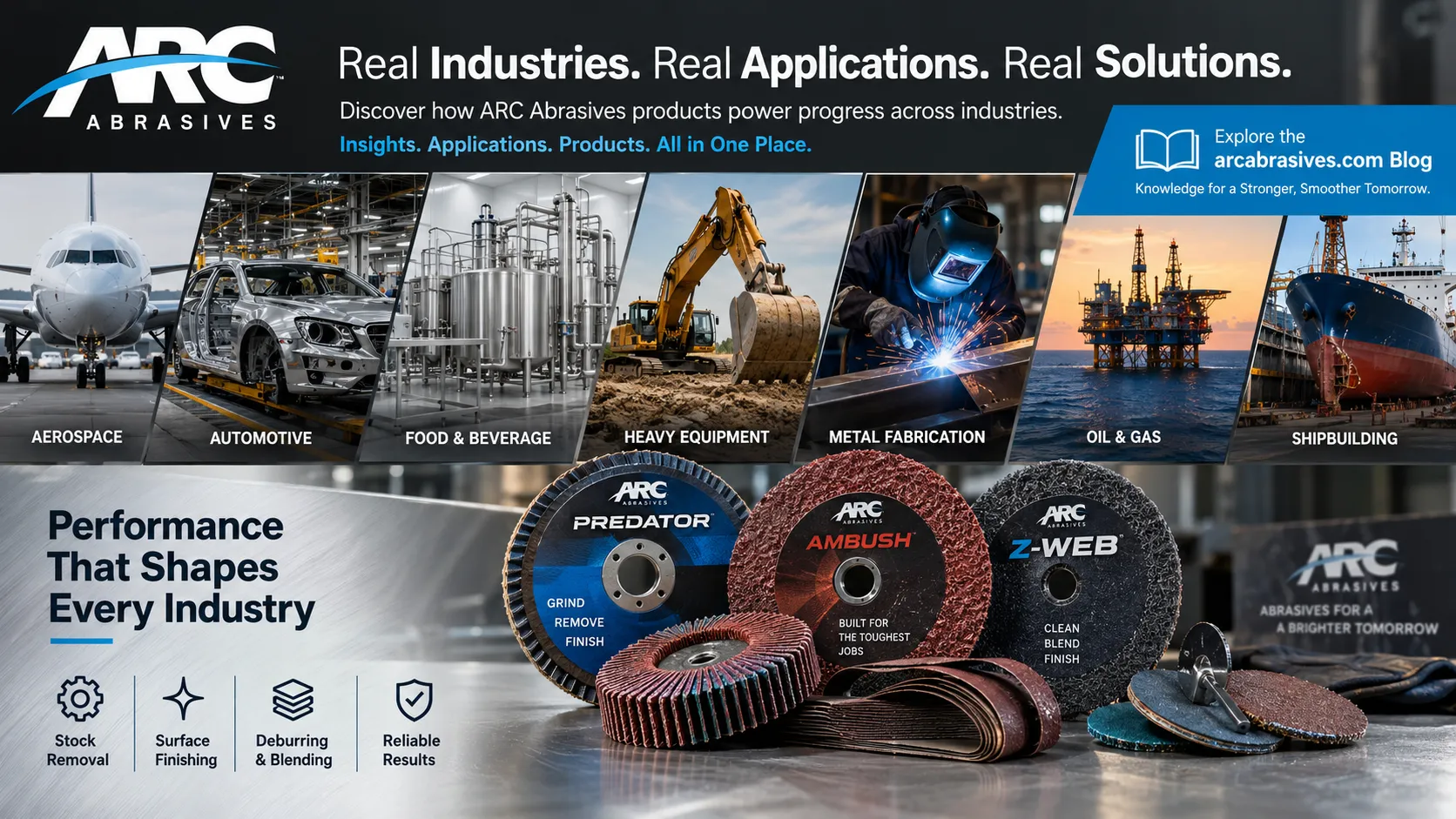
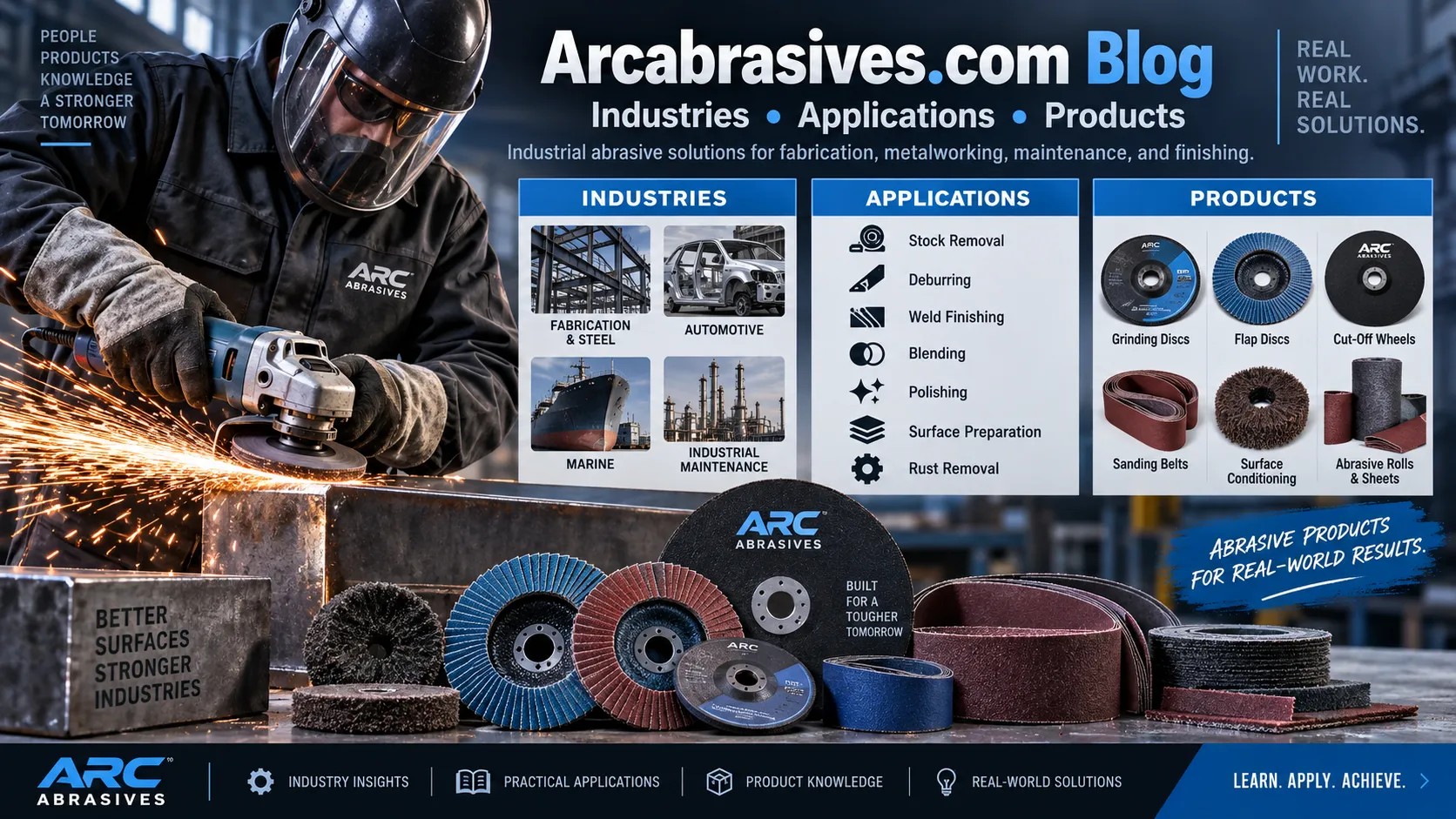
The Arcabrasives.com blog about industries applications products is the knowledge and resource section of ARC Abrasives, a U.S. abrasive manufacturer and converter serving metalworking, fabrication, maintenance, and finishing applications. Its content connects abrasive products with real industrial jobs such as stock removal, deburring, weld finishing, blending, polishing, surface preparation, and rust removal.
Rather than functioning as a general DIY sanding blog, ARC’s content is aimed mainly at industrial users, distributors, fabricators, maintenance teams, and buyers trying to match an abrasive to a material or process. The website combines educational articles, case studies, application information, product specifications, and an extensive searchable product catalog.
What Is ARC Abrasives?
ARC Abrasives Inc. is based in Troy, Ohio. According to the company’s history, Zerla and Si Stayman started the business in 1960 from their garage, originally operating as the Adhesive Research Company and producing a pressure-sensitive adhesive, or PSA, disc. The company states that it remains family-owned.
ARC later expanded into cartridge rolls, belts, quick-change products, flap discs, and other industrial abrasives. In 2016, the company moved into a 68,000-square-foot facility in Troy and expanded its manufacturing capabilities, including vertically integrated production of its Z-WEB non-woven abrasive line.
Its current website organizes products into major groups including belts, bonded wheels, discs, flap discs, flap wheels, Quick Loks, resin fiber abrasives, sheets and hand pads, rolls, specialties, unitized products, and related hardware.
The site is actively operating. Its homepage currently promotes a 2026 product catalog along with online ordering functions and current product inventory, although the public blog page itself presently shows articles through April 22, 2025.
What the arcabrasives.com Blog About Industries Applications Products Covers
The main purpose of the ARC Abrasives blog is to explain where abrasives are used and how different products fit specific manufacturing or repair processes.
One of its core articles, “Abrasives in Key Markets & Industries,” identifies nine major markets: aerospace, automotive, bio and pharmaceutical equipment, food and beverage, heavy equipment, medical, metal fabrication, oil and gas, and shipbuilding. It then connects each industry to common abrasive operations.
That application-first approach is useful because choosing an abrasive is rarely as simple as selecting a piece of sandpaper. The correct product depends on what material is being worked, how aggressively material needs to be removed, the desired final finish, tool speed, abrasive form, geometry, and other operating conditions.
Industries and Their Common Abrasive Applications
ARC’s industry guide provides a useful picture of how abrasive requirements change between sectors. The following table summarizes the applications specifically identified by the company.
| Industry | Applications highlighted by ARC |
|---|---|
| Aerospace | Blending forming or milling marks, cleaning application marks, deburring cutouts, edge radiusing |
| Automotive | Blending, forming and fabrication, light deburring, weld polishing, surface finishing |
| Bio & Pharma | Blending, deburring, forming and fabrication, weld finishing |
| Food & Beverage | Blending, deburring, forming and fabrication, weld finishing |
| Heavy Equipment | Deburring, weld removal, stock removal, surface finishing |
| Medical | Stock removal, polishing, finishing, deburring |
| Metal Fabrication | Stock removal, weld removal and finishing, forming and fabrication, deburring, blending |
| Oil & Gas | Stock removal, weld finishing, weld removal, deburring |
| Shipbuilding | Cutting, stock removal, weld removal, mill-mark removal |
These industries can use abrasives for very different reasons. A heavy-equipment fabricator may need rapid removal of weld metal or substantial surface preparation, while a medical-component manufacturer may place greater emphasis on controlled finishing and dimensional accuracy.
Aerospace
ARC identifies titanium, stainless steel, and aluminum as materials commonly encountered in aircraft manufacturing. Its highlighted abrasive operations include blending machining marks, cleaning surfaces, deburring cutouts, and producing an appropriate edge radius.
This is a good example of why abrasive selection must consider more than removal speed. Parts used in demanding applications can require controlled finishing without unnecessarily removing surrounding material or causing excessive heat.
Automotive
Automotive manufacturing and repair can involve forming, fabrication, blending, light deburring, weld polishing, corrosion removal, and surface finishing. ARC’s own blog illustrates this connection through a Z-WEB Quick-Lok case study involving rust and corrosion on an automotive brake assembly.
The application can therefore range from aggressive manufacturing work to comparatively light surface conditioning during maintenance.
Food, Beverage and Pharmaceutical Equipment
ARC groups many food, beverage, and pharmaceutical applications around stainless-steel fabrication, blending, deburring, and weld finishing. Its website also maintains dedicated food and pharmaceutical application resources covering equipment such as tanks, process vessels, reactors, commercial kitchen equipment, sinks, countertops, and prep tables.
For equipment used in sanitary environments, the required finish should be determined by the applicable equipment specification, customer requirement, hygienic-design standard, and regulatory environment. A manufacturer’s abrasive recommendation alone should not be treated as proof that a finished component meets a particular regulatory requirement.
Heavy Equipment and Metal Fabrication
These are among the clearest use cases for aggressive industrial abrasives. ARC associates heavy-equipment work with stock removal, weld removal, deburring, and finishing, while its metal-fabrication section adds blending and forming or fabrication work.
The company has also published a metal-fabrication case study involving its AMBUSH ceramic flap discs. ARC reports that one AMBUSH disc completed work equivalent to three competitor discs in that particular test and calculated estimated annual savings of about $22,000. Those results should be understood as a manufacturer-published case study, not a universal independent performance benchmark. Actual results can change with material, pressure, grinder power, operator technique, abrasive size, and production conditions.
Oil, Gas and Shipbuilding
ARC highlights substantial material removal and surface preparation in both sectors. Oil and gas applications listed by the company include stock removal, weld finishing, weld removal, and deburring. Shipbuilding applications include cutting, stock removal, removing welds, and eliminating mill marks before subsequent surface treatment.
These are good examples of operations in which the required abrasive can change substantially between fabrication, coating preparation, maintenance, and repair.
The Main ARC Abrasive Product Families
ARC’s catalog is broader than the three proprietary product lines most prominently featured in its marketing. The current online catalog contains belts, bonded wheels, discs, flap discs, flap wheels, Quick Loks, resin fiber products, sheets and hand pads, rolls, specialties, unitized abrasives, and hardware.
The catalog also allows products to be filtered by properties including grit, dimensions, product line, attachment, maximum RPM, and intended market application. Application filters currently include blending, cleaning, cutting, deburring, finishing, flash removal, grinding, polishing, rust removal, stock removal, stripping, surface preparation, weld blending, and weld removal.
That structure is important. It means arcabrasives.com is not simply an online store organized by product names. Users can approach the catalog from the job they are trying to accomplish.
PREDATOR, Z-WEB and AMBUSH Explained
ARC currently emphasizes three proprietary abrasive families, each intended for somewhat different types of work.
PREDATOR
According to ARC, PREDATOR products combine zirconia alumina with self-sharpening ceramic abrasive grain. The company positions the range for aggressive cutting, stock removal, and deburring on materials including mild steel, stainless steel, aluminum, and some higher-performance alloys.
PREDATOR products are offered across multiple abrasive formats, including belts, discs, flap discs, resin fiber discs, Quick Loks, and bonded wheels. This makes it more of a grain and product technology family than a single abrasive format.
Z-WEB
Z-WEB is ARC’s non-woven surface-conditioning range. ARC describes it as a three-dimensional abrasive construction intended primarily for finishing, cleaning, and lighter grinding operations on materials such as stainless steel, titanium, and other alloys.
The company offers Z-WEB in formats including discs, belts, and Quick Loks and promotes it for applications where controlled surface conditioning is more important than highly aggressive stock removal.
AMBUSH
AMBUSH is ARC’s full-ceramic abrasive line. The manufacturer describes its ceramic material as continuously self-sharpening and positions the products for demanding work including stock removal, beveling, and weld grinding on stainless steel, titanium, and high-nickel alloys.
ARC’s current homepage also promotes AMBUSH resin fiber discs, showing that the product family has continued to expand beyond the formats described on some older product-line pages.
How to Choose an Abrasive from the ARC Catalog
A useful way to use the ARC website is to start with the operation rather than with a brand name.
Consider the workpiece material, whether it is mild steel, stainless steel, aluminum, titanium, another alloy, or a coated surface. Then define the operation clearly: cutting, heavy grinding, stock removal, weld leveling, deburring, blending, rust removal, surface preparation, or final finishing.
After that, check the product form and specifications:
- Match the abrasive to the material and required application.
- Choose an appropriate grit and product geometry for the amount of material that must be removed and the finish required.
- Confirm that the disc, belt, wheel, Quick Lok, or other abrasive fits the intended machine and attachment system.
- Check the abrasive’s rated maximum speed against the machine before use.
- Review the manufacturer’s product information and Safety Data Sheet where applicable.
- Test the process on representative material when surface finish, heat generation, dimensional tolerance, or production cost is critical.
ARC’s redesigned website specifically advertises more detailed product specifications, Safety Data Sheets, product imagery, online ordering and tracking for authorized distributors, and a distributor-locator function.
Grit, Stock Removal and Surface Finish
The ARC catalog currently spans grits from very coarse industrial products into much finer abrasive grades, depending on product family. It also separates products by their intended application rather than implying that one grit works universally.
In practical terms, abrasive choice involves a tradeoff. More aggressive products are useful when the priority is removing metal or leveling a weld quickly, while finer or non-woven products are more appropriate when the aim is controlled blending, cleaning, polishing, or preparing a consistent surface.
The exact result also depends on contact pressure, tool speed, abrasive construction, backing, grain type, workpiece material, and operator technique. For production work, comparing total process time and abrasive consumption can be more meaningful than comparing the purchase price of individual discs.
Safety Matters as Much as Abrasive Performance
Industrial abrasive products can operate at very high rotational speeds, so compatibility with the machine is essential.
OSHA’s abrasive-wheel guidance requires appropriate guarding for covered abrasive-wheel machinery. Its grinder checklist also calls for checking that the maximum RPM rating of an abrasive wheel is compatible with the grinder’s RPM and that new wheels are inspected before mounting.
Product selection should therefore never be based solely on how quickly an abrasive cuts. Machine compatibility, rated operating speed, guarding, mounting method, condition of the abrasive, workplace controls, and the manufacturer’s instructions all matter.
What Makes the ARC Blog Useful?
The strongest part of the ARC blog is its connection between industry, application and abrasive format. A reader can move from a problem such as weld removal or surface conditioning to relevant product categories rather than trying to decode thousands of individual SKUs without context.
The blog also includes application case studies, product technology explanations, corporate updates, and articles about manufacturing practices. Current visible posts include an AMBUSH metal-fabrication case study, a Z-WEB automotive-brake case study, an overview of coated abrasive engineering, an industry guide, a website-redesign announcement, and a sustainability article.
There is an important limitation, however. The ARC blog is produced by ARC Abrasives itself. It is a valuable primary source for understanding the company’s products, specifications, intended uses, and claimed test results, but promotional performance statements should not automatically be treated as independent comparative testing.
For a production process involving significant cost, safety risk, regulated equipment, or tight finishing tolerances, users should verify performance under their own operating conditions and refer to applicable technical and safety standards.
Is arcabrasives.com Still Active?
Yes. The website is currently functioning as ARC Abrasives’ official product and company site and presents an active product catalog, account functions, inventory information, same-day-shipping options, and a 2026 product catalog.
The blog itself appears less frequently updated than the commercial catalog. The main public blog page currently displays its most recent visible article as April 22, 2025, even though the broader site contains 2026 product material.
Pricing is also not completely open. Many catalog entries display “Login to see pricing,” and ARC says authorized distributors can access pricing, quick ordering, order status, and account information through registered accounts.
ARC Abrasives and ISO Quality Management
ARC’s website states that the company operates an ISO 9001:2015 quality management system and describes its quality program as including product testing, continuous improvement, process development, lean-manufacturing practices, and Six Sigma principles.
This should be interpreted correctly. ISO 9001 is a quality-management-system standard, covering how an organization establishes, controls, evaluates, and improves quality-related processes. It is not by itself a guarantee that every individual abrasive will outperform competing products in a specific application.
There is also a timely detail for readers checking certification information. ARC’s website currently references ISO 9001:2015, while ISO published the new ISO 9001:2026 edition on September 16, 2026. Buyers who require a specific certification version for supplier qualification should therefore request ARC’s current certificate and verify its scope and transition status directly rather than relying only on website wording.
Who Will Find the ARC Abrasives Blog Most Useful?
The resource is particularly relevant to people involved in metal fabrication, production engineering, industrial maintenance, welding, surface finishing, purchasing, and abrasive distribution.
It is most useful when the reader already knows the basic process problem, such as excessive weld-removal time, difficult deburring, rust removal, unwanted surface discoloration, insufficient finish consistency, or excessive abrasive consumption. The blog can then help narrow the type of product worth investigating.
For consumers looking only for ordinary home sandpaper advice, however, much of the material will be more industrial and technical than necessary.
FAQ
What is the arcabrasives.com blog about industries applications products?
It is ARC Abrasives’ industrial knowledge section covering abrasive applications, manufacturing industries, product technology, case studies, and company developments. Much of the content explains how products such as belts, discs, flap discs, Quick Loks, resin fiber discs, and non-woven abrasives relate to specific metalworking jobs.
What industries does ARC Abrasives serve?
ARC’s industry article specifically discusses aerospace, automotive, bio and pharmaceutical equipment, food and beverage, heavy equipment, medical, metal fabrication, oil and gas, and shipbuilding.
What are the main ARC Abrasives product lines?
The three proprietary lines most prominently highlighted are PREDATOR, Z-WEB, and AMBUSH. PREDATOR combines zirconia alumina and ceramic grain, Z-WEB is a non-woven surface-conditioning system, and AMBUSH uses full-ceramic abrasive material.
Can you buy products directly from arcabrasives.com?
The website has e-commerce and account functionality, but pricing visibility depends on account access. Many products currently require users to log in to see pricing, while authorized distributors receive online ordering and account features.
Is ARC Abrasives an American manufacturer?
ARC states that it manufactures in the United States and operates from Troy, Ohio. Its company history says the business started in Troy in 1960 and moved into its current 68,000-square-foot facility in 2016.
How do I know which ARC abrasive to choose?
Start with the workpiece material and the job you need to perform, then narrow the catalog by application, abrasive format, grit, dimensions, attachment system, and maximum RPM. For production-critical work, confirm manufacturer specifications and test the abrasive under representative operating conditions before standardizing the process.
Also Read: Beauty Fashion Makeup Skincare Blog Favorites LTK ShopMy Guide
